info@helpwithnursingassignments.co.uk
Nursing is not a static profession. It is a dynamic field where professions change, new medications are approved, and treatment guidelines evolve almost every day. For nursing students, this constant change can be overwhelming.
How do you know what to trust? This is where Evidence-Based Practice (EBP) comes in.
If you are a nursing student, you are likely groaning at the thought of another research paper or care plan requiring peer-reviewed citations.
But remember, these assignments are not just academic hurdles; they are training simulations for your future career.
So let’s begin this guide and understand why evidence-based practice is important for nursing assignments, more importantly, for patient safety.
What is Evidence-Based Practice?
Before we dive into assignments, let’s clarify the concept.
Evidence-based practice in nursing is a problem-solving approach to clinical-decision making. It integrates three main pillars:
- Best available research evidence.
- Clinical expertise (what the nurse knows).
- Patient values and preferences.
For a nursing student, this means that you cannot simply rely on what you read in a textbook ten years ago. You must find relevant and current peer-reviewed data to support your nursing interventions.
The 5-Step EBP Processes (5 As)
- Ask: Formulate a clinical question using the PICO format (Patient, Intervention, Comparison, Outcome).
- Acquire: Search for the best, most relevant evidence.
- Appraise: Critically assess the validity and relevance of the evidence.
- Apply: Integrate the evidence with clinical expertise and patient preference into practice.
- Assess: Evaluate the outcome of the change to determine effectiveness.
Importance of Evidence-Based Practice in Nursing Assignments
1. Bridging the Theory-Practice Gap
|
Did you know? According to the Landmark RAND study, American adults receive only about 54.9% of recommended, evidence-based care. |
One of the biggest challenges that I observed during my academia was reality shock. Textbooks often provide an ideal scenario, but real patients come with complex diseases and medical conditions.
Hence, you have to look beyond the textbook while writing your nursing assignment using EBP. Moreover, you learn to search database on CINAHL or PubMed for recent studies.
This process teaches you that medicine is dynamic. For example, an infection control technique you learned in your first semester might have been updated by new research in your third year.
2. Improving Patient Safety Outcomes
Evidence-based nursing assignments often involve creating care plans or analysing case studies. When you base these plans on evidence, you prioritise patient safety.
Let’s consider Central Line-Associated Bloodstream Infections (CLABSI). Years ago, dressing changes were done based on tradition. Today, EBP guidelines dictate specific sterile protocols that have drastically reduced infection rates.
Research published in the Worldview on Evidence-Based Nursing Journal suggests that hospitals with a strong EBP culture have low mortality rates and reduced hospital costs.
Therefore, practising this in your school means you are rehearsing the decisions that will lower mortality and morbidity in your future workplace.
3. Developing Critical Thinking
Nursing is not about memorising, it’s about critical thinking. EBP assignments require you to appraise literature.
You have to ask:
● Is this study reliable?
● Was the sample size sufficient?
● Does this apply to my patient?
I remember reviewing a student’s care plan in my early teaching career. The student has suggested an intervention based on a blog post rather than a clinical guideline. So we sat down to discuss why that source was not credible and I offered some effective evidence-based writing help for a clear understanding. After that, students stopped looking for easy answers and started finding proven answers.
Critical thinking empowers you to question protocols if they are not supported by data. This makes you a stronger advocate for your patients.
4. Preparation for the NCLEX Exam and Professional Life
Let’s be honest. Passing the NCLEX-RN exam is the primary goal of every nursing student. In addition, it heavily focuses on critical thinking. Also, many questions are scenario-based and require you to choose the actions supported by current best practices.
Furthermore, Magnet-designated hospitals (recognised for nursing excellence) require nurses to participate in EBP projects.
Hence, if your assignments are grounded by EBP, you are essentially studying for the NCLEX with every paper you write.
How to Structure an EBP Nursing Paper?
An EBP nursing paper requires a logical flow that demonstrates clinical decision-making. The following is the structure generally used in an EBP nursing paper:
● Introduction: state the clinical problemits significance, and your PICOT question.
● Methodology: Describe your search strategy, including the database used. Also, detail why certain studies were chosen, and others were rejected.
● Literature review/Synthesis: evaluate the quality and validity of your sources using the established Critical Appraisal Tool. Then group these articles by themes and show the current stage of knowledge.
● Implementation Plan: explain how the evidence will be applied in a clinical setting. Also, consider potential barriers and necessary resources. Make sure to describe how you will measure the success of an intervention.
● Conclusion and Recommendations: Reiterate how the evidence answers your PICOT question. Also, state how this change improves nursing practice and patient outcomes.
● References: provide a complete list of all cited sources formatted exactly according to the required style (APA 7th edition).
What are the Evidence-Based Research Levels?
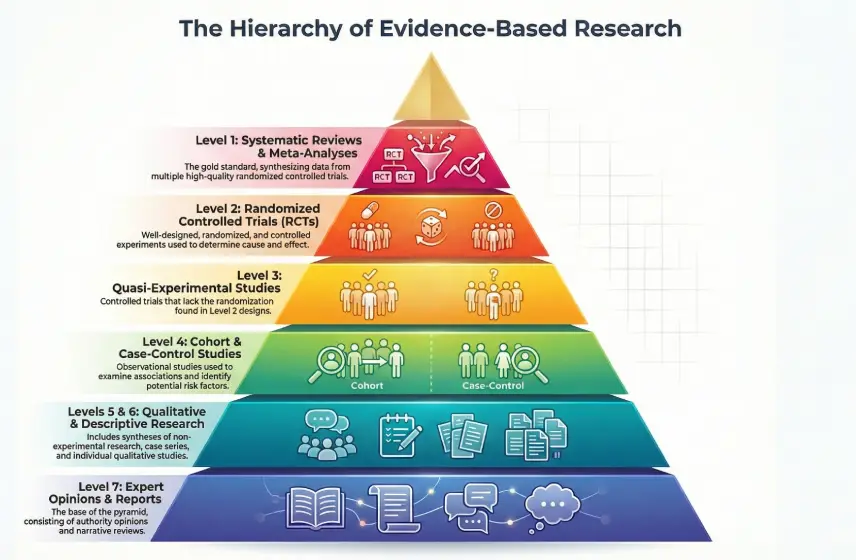
Evidence-based research levels rank study designs within a 7-level hierarchy, from top-tier systematic reviews to expert opinions. In addition, it uses a pyramid structure where higher levels indicate less bias.
These are:
|
Level 1: Systematic Reviews and Meta-Analyses of RCTs ● Synthesise data from multiple, high-quality randomised controlled trials (RCTs). Level 2: Randomised Controlled Trials (RCTs) ● Well-designed, randomised, and controlled experiments. Level 3: Quasi-Experimental Studies ● Controlled trials without randomisation Level 4: Cohort Studies and Case-Control Studies ● Observational studies examining associations and risk factors Level 5: Systematic Reviews of Descriptive and Qualitative Studies ● Synthesise findings from non-experimental research Level 6: Single Descriptive or Qualitative Studies ● Individual studies, for example, case series or individual studies Level 7: Expert Opinions and Reports ● Opinions of authorities, expert committee reports, or narrative reviews. |
Final Words
Evidence-based practice is not just a requirement for nursing assignments. It is the foundation of safe and efficient patient care.
By mastering EBP now, you bridge theory and practice, sharpen your critical thinking skills, boost patient safety, and gear up for the NCLEX exam.
Embrace the 5 As, structure your papers, and prioritise high-level evidence to stand out in your studies and future roles.
Start applying these strategies in your assignments now!
FAQs
What is the main purpose of evidence-based nursing?
The EBP process allows practitioners to evaluate research, clinical guidelines, and other information resources based on quality findings. It then applies the results to practice.
What are good EBP nursing topics?
Some of the effective and good EBP nursing topics in 2026 are:
● Infection control and safety. For example, reducing Catheter-Associated Urinary Tract Infections (CAUTI), improving hand hygiene compliance, or reducing medication errors.
● Clinical care and patient outcome. For example, sepsis screening and early intervention protocols, pain management techniques, post-operative care, and others.
● Mental health and specialised care. For example, trauma-informed nursing care, strategies to manage long COVID symptoms, etc.
What are the three types of evidence-based practice in nursing?’
The three types of evidence-based practice in nursing are:
- Clinical expertise/expert opinion
- Evidence (internal or external)
- Client/patient/caregiver perspective
What is an example of an EBP question?
Here’s an example of an EBP question:
In patients 65 years or older (P), how does the use of an influenza vaccine (I) compared with not receiving a vaccine (C) influence the risk of developing pneumonia (O) during flu season (T)?
What is the first step in evidence-based practice?
The first step in evidence-based practice is to formulate a clinical question. In addition, it should be relevant to the patient or the problem and constructed so as to help you find the answer.