info@helpwithnursingassignments.co.uk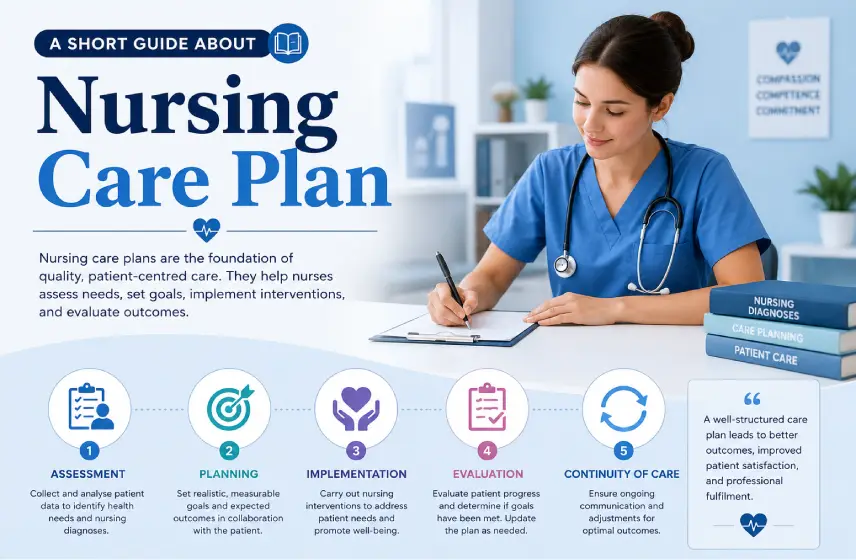
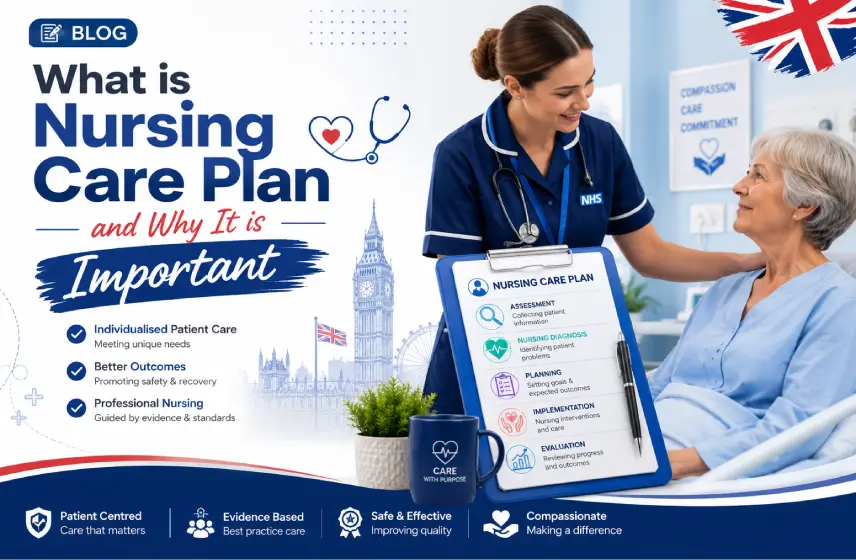
Nursing care plans are documents that include nursing diagnoses for nurses to get a better understanding of a patient's specific medical needs, conditions, and requirements. By developing a detailed nursing care plan covering a patient’s all medical information, the nurses get insight of the patient's health condition, making them able to prioritise and establish goals and judge the outcomes related to particular disease procedures. A care plan plays an important role in reducing the communication barrier among nurses and other members of the care team and making sure that high-quality, continuous, and evidence-based care is provided.
Writing a helpful nursing care plan requires a step-by-step process to accurately cover all the important parts of a care plan. This guide will lead you through creating a proper nursing care plan
How to Develop a Nursing Care Plan: A Step-by-Step Guide
A nursing care plan is more than just a document, you can think of it as a roadmap that provides a patient’s health journey from the beginning. Nurses often use it as structured documentation to get all the important information in one place to make sure a patient's care is organized, consistent, and most importantly evidence-based. By using the nursing care process nurses not only address physical health but also mental and social needs of the individual.
Even though different healthcare departments may use different digital formats, the basic principles of the nursing care plan remain the same.
The following sections break down the important parts of developing an effective nursing care plan.
1. Patient Assessment:
The first step of the nursing care plan is often considered as the most critical stage of the nursing process, as it describes the foundation of every succeeding decision. During this initial stage, the nurse is responsible for collecting and organising data to create a complete clinical picture.
Assessment is divided into two categories:
Subjective data: Subjective data includes what the patient tells you. For example, if the patient says: “I feel nauseous".
Objective data: The Objective data Includes measurable facts, such as a blood pressure reading.
Healthcare assistants help nurses in taking routine measurements, but the registered nurse is in charge of maintaining this data and should make sure of the clinical accuracy, reviewing the patient’s medical history is also a part of this step, as a detailed assessment makes sure that no underlying issue is overlooked, which allows a care plan to be truly balanced with the patient’s specific preferences.
2. Nursing Diagnoses
After collecting the data and finalizing it nurses are supposed to move towards the diagnostic phase. It is important that you understand that a nursing diagnosis is far different from a medical diagnosis, as a medical diagnosis identifies a disease, the nursing diagnosis identifies the patient’s response to that disease.
Nurses use standard classifications to create a clear communication environment across the team. This section of the plan focuses on identifying the main health issue, its symptoms, and potential risks. By finding out the problem accurately, the nurse can target the specific human response that requires nursing care. This clinical judgement helps prioritise care, and makes sure that any life-threatening issue is addressed first.
3. Setting Goals
After identifying the diagnoses, the nurse must outline the desired outcomes and determine what the patient needs to achieve, which is marked as the destination for the care plan, In nursing industry there is a term used for an effective plan which describes what is needed to achieve an effective result, known as SMART: Specific, Measurable, Achievable, Relevant, and Time-bound.
Goals are usually divided into two types: long-term goals and short-term goals. The short-term goals are directed towards immediate needs while the long-term goals are more focused towards big milestones.
It’s a nurse’s responsibility to align the goals with the nursing diagnosis, to make sure that the care provided is purposeful and result-oriented.
4. Execution:
This part is also known as implementation, this is where the main work of nursing happens. This section explains exactly what the nursing team will do to help the patient reach their desired goals, it can also includes managing medication, performing wound care, or providing education on post-operative careFor this part the consistency is the only key, by documenting the daily actions performed, the nursing team makes sure that high quality medical support and continuous monitoring is provided, so it can be provided as legal record of the care provided and makes sure that regardless of which nurse was on duty, the patient;’s care was never compromised and the patient received the same same high standard of evidence based care.
5. Evaluation
Evaluation is the final part of the nursing care plan, this is a continuous process where the nurse examines how well the patient responded to the interventions, and compares the patient’s current status against the goal set earlier to see if they were met, partially met, or not met.
If goals were met, then the nurse may decide the specific problem is resolved and set new, or more advanced goals to keep the patient improving, but if the goals were not met, then the nurse must change the plan to try something else. Based on this analysis, the nurse changes the plan, and tries different strategies, to start this process again.
In conclusion, a helpful nursing care plan is a living document. It changes as the patient’s condition changes, and makes sure that nursing care remains active, personalised, and effective throughout the entire healing process.
These documents allow healthcare providers to deliver excellent, patient-focused care. Beyond organising daily tasks, care plans guarantee personalized care delivery, and facilitate smooth transitions across healthcare environments, and help improve team communication. Ultimately, a well-developed care plan provides an important legal framework while focusing on both patient recovery rates and overall satisfaction.