info@helpwithnursingassignments.co.uk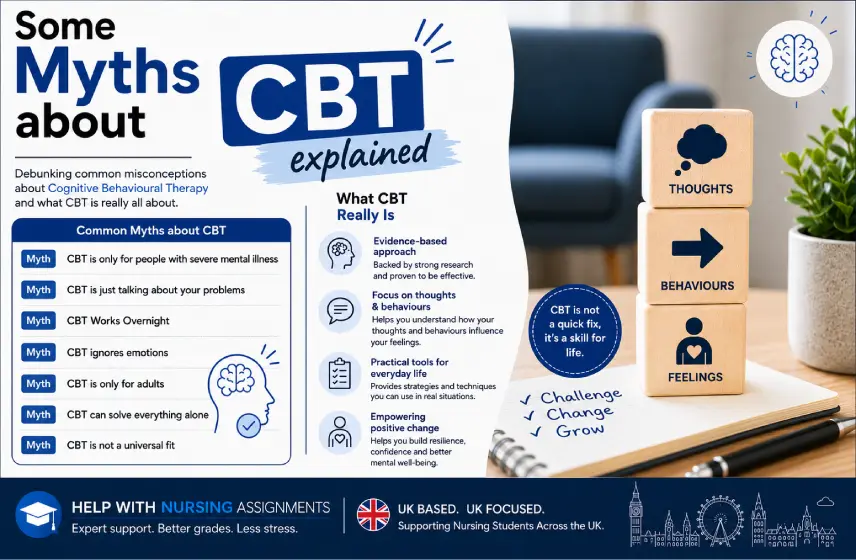
Nursing students and healthcare workers!
You know Cognitive Behavioral Therapy (CBT) is the most popular psychological therapy. According to NLM studies, CBT is effective, as 70% of participants experienced improvement.
However, there are many myths about CBT. These myths can prevent people from getting the help they need. So, let’s debunk the most popular myths and see what the truth is.
Myth 1: CBT is Only for People with Severe Mental Illness
There is a false assumption that CBT is for those with serious mental health issues. But that is not the case. You can use CBT for everything. That is to say, no mental illness is small. Whether you are feeling a bit anxious or dealing with obsessive thoughts. You need to use CBT.
To debunk this myth, we must understand that CBT is not all about dealing with problems. It is about getting better at managing your emotions or finding new ways to cope. So, who doesn't want that?
In other words, CBT is a big help for everyone who wants to understand their emotions. Read that again, CBT helps you handle your emotions. It doesn't just talk about your problems!
Myth 2: CBT is just Talking About your Problems
Do you think CBT is nothing more than a conversation? If so, then you may be holding onto a common myth.
In simple CBT practice, you create three columns for thoughts, feelings, and actions. So, CBT can help you change your thoughts and the outcome. In other words, CBT is all about learning how your mind works.
It focuses on identifying and reshaping negative thought patterns. Moreover, it teaches practical ways to cope with everyday challenges. That is why some people call it “homework therapy,” because CBT often includes:
-
Keeping a journal
-
Trying out new skills
-
Challenging unhelpful thoughts
-
Practicing relaxation techniques
With these simple practices, you can start to feel better and make positive changes in your life. Through CBT, you can learn how to identify patterns in your thoughts and feelings. So, you can change them in ways that will help you to feel better. CBT is a practical approach to therapy, and it can help you manage anxiety and depression. But it takes time!
Myth 3: CBT Works Overnight
Imagine a patient left their therapy session because they were feeling frustrated. They thought a few sessions would fix everything. But change doesn’t happen all at once. CBT is a practice. The more you apply it, the more your thinking and actions begin to shift.
In other words, progress is not instant, but it is possible. So, be patient!
To debunk this myth, you must understand that you won't see results right away. It takes time for CBT practices become part of your life and helps you understand your feelings. Understanding feelings? Does that mean we rationalise them? Read the next myth to find out!
Myth 4: CBT Ignores Emotions
It is a misconception that CBT is cold logic. But in truth, it is more like a flashlight in a dark room. It helps you see your feelings so you can navigate them and not ignore them.
CBT helps you understand how your thoughts, feelings, and actions are all connected. So, how can it ignore emotions?
For example, imagine you are nervous about giving a presentation. CBT can help you figure out what is causing those nervous thoughts and replace them. So, this way, you can manage your nerves and feel more confident.
You don't rationalise or ignore your feelings. CBT helps you find a healthier way to deal with them, rather than trying to suppress them. But can children use CBT? Worried about the growing mental health challenges in kids? Then don't miss reading the next myth!
Myth 5: CBT is only For Adults
WHO reports that 1 in 7 adolescents aged 10 to 19 experiences a mental health disorder like anxiety, depression, or behavioral issues. This shows that mental health challenges among children and teens are on the rise.
CBT can also be helpful for kids and teenagers. So, let's debunk the myth that CBT is only for adults.
CBT therapists tailor their approach to a child’s age and maturation. For younger kids, they might use fun games to explore and challenge negative thoughts. For teenagers, they focus on practical strategies to handle everyday challenges.
But hold on, reading about how effective CBT is in this blog. Ask yourself: have you fallen for the myth that it can fix everything? Let’s debunk that next! Let’s debunk that next!
Myth 6: CBT Can Solve Everything Alone
CBT can be powerful, but it is not a magic recipe that works the same for everyone. Some people might need to:
-
Take medicine
-
Change their daily habits
-
Try other types of therapy
-
Learn coping strategies
The best way to deal with a problem is to mix and match different approaches to fit what the person needs. In other words, CBT is more effective when combined with other therapies. So, your patient can find what works best for them and make progress tailored to their unique needs.
Myth 7: CBT is not a Universal Fit
Did you hear someone say, "unique needs?" So, that means CBT is not rigid. Therapists tailor to each person. They plan each session to meet the patient's specific needs and thought patterns.
For example, nursing students who are struggling and looking for nursing term paper help. They can contact services that offer nursing assignment help to apply CBT techniques. This can help them get back on track. This shows how versatile these techniques are. Whether you are dealing with anxiety, stress, or need help with studying, CBT can be a useful tool.
Why Does Understanding These Myths Matter?
In a recent study, 58% of students are reluctant to seek help for mental health problems. If misconceptions surround CBT, people may hesitate to try it.
So, as a healthcare worker or nursing student, it is your duty to debunk these myths. It will help people to start therapy with a clear understanding of what to expect. So, they will be willing to give it a chance.
CBT is not a quick fix. However, it can be effective if you encourage them to be consistent. This approach can help people make real progress and improve their lives.
Final Thoughts
Nursing students and healthcare workers!
Cognitive Behavioral Therapy is a versatile and practical therapy. It is helpful for adults, students, children, and everyone. So, help people understand their thoughts, you must bust these myths.
This will help people understand the true power of CBT and inspire them to use it with confidence.