info@helpwithnursingassignments.co.uk
I never planned to write any of this down. But after eleven years working on a mental health ward, I have realised that some stories deserve more than a clinical entry in a patient file. Some moments deserve to be remembered. And these moments are especially helpful for anyone who is in the same place where I was. And wondering if they are strong enough to do this job.
So here it is. My journey. The real one.
The Day I Nearly Quit
It was my third year. I was working nights on an acute ward, and we were short-staffed again. There was this patient, umm, let’s call him Marcus. This man was in his forties and had been admitted after a serious attempt on his life. He did not utter a word. He sat in the same chair by the window for two weeks. And he only stared at the car parked below. I’d often thought about what to do, how to bring him back, and whatnot.
I tried everything. Small talk. Silence. Tea. Sitting next to him without saying a word. Nothing worked.
I started taking it personally. You know the way you do when you are young and still learning where the job ends, and you begin.
One night, I checked in with him, and he was still awake. I sat down right next to him. I did not say anything. And then, after maybe ten minutes of pure silence, he said:
“I used to watch birds before all this. I had feeders in the garden. Seven different species came. I knew all their names.”
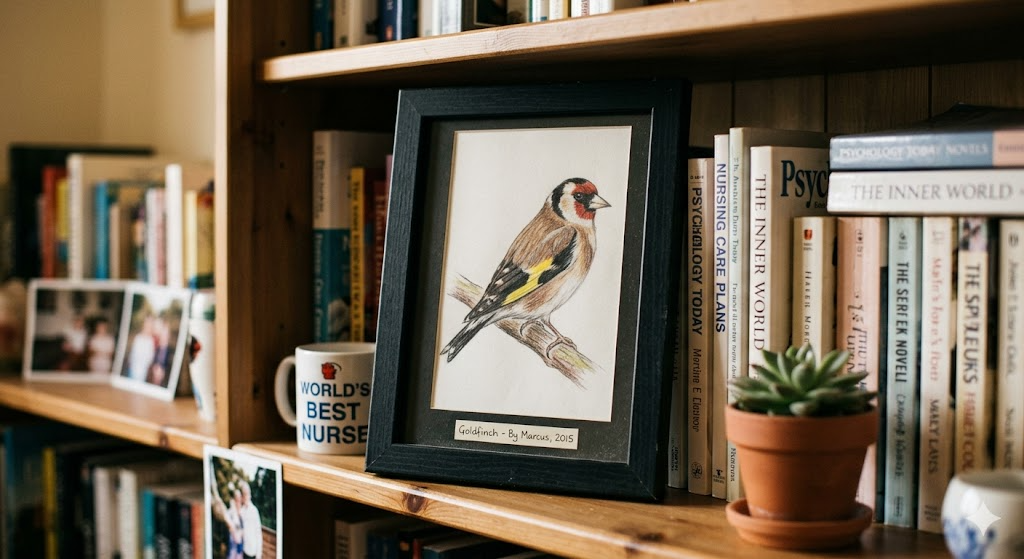
I asked him what his favourite was. He said a goldfinch. I immediately had the image of this brown, black, yellow, and red colored bird in my mind.
I went home that morning and cried in the car. Not out of sadness. I just could not fully explain it then. It was something closer to gratitude. He had let me in, just a crack, and it felt enormous.
Marcus was discharged six weeks later. On his last day, he brought a picture he had drawn. It was a goldfinch, done in coloured pencils. He left it at the nurses’ station without a word. I have kept it. It is in a frame on my bookshelf at home.
I never nearly quit again after that.
What Nobody Prepares You For
Training prepares you for a lot of things. It prepares you for medication errors, risk assessments, safeguarding protocols, and the theory behind cognitive behavioural therapy.
What it does not prepare you for is the weight of carrying other people’s pain home with you quietly and almost invisibly. It feels like something tucked into the lining of your coat.
I started noticing it around year four. I’d be in the supermarket and see someone in distress, a stranger crying in the cereal aisle, and my body would go into work mode before my brain could catch up. I’d be in at a dinner with friends, and someone would mention feeling low, and I’d already be running a risk assessment in my head.
The Royal College of Nursing has written about this, the way emotional labour erodes mental health nurses ' mental health over time if it is not actively managed. When I read that, I felt seen for the first time in a way that no supervision session had quite managed.
The loneliness of it surprised me most. You cannot really explain the weight of a shift to someone who has not done it. You do not want to burden your family. So you sit with it. You develop a kind of double life. The person at work who is steady and calm, and the person at home who sometimes just needs to stare at the ceiling for a while.
I am not saying this to put anyone off. I am saying it because pretending it does not happen is part of the problem.
The Night I Wrote a Song
This is part I have never told anyone at work.
About six years into the job, I had a particularly brutal run of shifts. We lost a patient - not in the ward, but shortly after discharge. It is the call nobody wants to take. I sat through the debrief, I said the right things, and I went home.
At 1 AM, I could not sleep. I picked up my guitar, which I had barely touched in years. And I just started strumming. Words came out that I had not known were there.
The Patients Who Changed Me
I have worked with hundreds of patients. Each one has left something behind. A phrase, a lesson, a shift in how I see the world.
There was a woman. I will call her Olivia. She was admitted with severe postpartum psychosis. She was convinced her baby was replaced. She screamed at her husband when he visited. She refused to eat for three days.
I remember sitting with her on day five, just the two of us, and she grabbed my hand and said:
“I know something is wrong with my thinking. I know it up here.” - she pointed to her head - “but I can’t stop it. It’s like watching yourself from outside and not being able to get back in.”
That description stopped me cold. The insight she had, even in the middle of the psychosis, was extraordinary. She was not lost. She was trapped. There is a difference. And learning to see it changed how I approach every patient since.
Olivia recovered fully. She sent a card to the ward when her daughter turned one. On the front was a photo of the two of them. On the inside, she wrote: “We made it.” We put it on the staff board. It stayed there for two years.
What the Numbers Don’t Show
According to Mind, approximately 1 in 4 people in the UK will experience a mental health problem each year. That is the number I think about often. It means this work is not niche. It is not marginal. It sits at the very centre of healthcare, and yet mental health nursing still does not get the recognition it deserves.
NHS workforce data shows around 40,000 mental health nurses working in England, but vacancy rates remain high, and burnout is pushing experienced nurses out of the profession every year. We are losing people who took a decade to become truly skilled. That number should frighten all of us.
What the number does not show is what we carry. The 3 AM shifts. The goldfinch drawings. The cards of the staff board. The songs written in the dark.
To Nursing Students Reading This
If you are a nursing student reading this, I want to say something to you:
It is supposed to feel like this.
Not the burnout. Not the breaking point. But the uncertainty and the moments when you feel if you are in the right place. That is not a red flag. That is what it means to take it seriously.
The academic side of the nursing training is hard. And finding the right support matters. When I was struggling with my dissertation in my second year, I wish I had known about resources like nursing dissertation help. They help you become a better nurse rather than drowning in referencing styles at midnight.
Final Words
People often ask me what keeps me in this profession. Eleven years in, and this question comes up at dinner parties and in job interviews from student nurses on placements who are quietly checking whether I regret it.
I do not regret a single shift.
Not the 3 AM ones. Not the debriefs. Not the paperwork that ate three hours I should have spent with patients. Not the days I drove home so tired I sat in the car park for twenty minutes before I could face going inside.
What keeps me here is simple: this work matters in a way that is impossible to fake.
When someone trusts you at their lowest, when they tell you something they have never said out loud- that is the privilege unlike anything else in the world. You earn it through showing up consistently and meaning it.
The goldfinch drawing is still on my shelf. Olivia’s card is in a box. And the song I wrote- I still recall it.
These are the things nobody tells you about mental health nursing when you are starting.
These are the reasons you stay.