info@helpwithnursingassignments.co.uk
|
According to a study in a nursing program, it was found that nearly 73% of nursing students had difficulty in understanding the fundamentals of scientific writing structures, techniques, and proper citation. |
Nursing is a demanding profession. Nursing students frequently struggle with scientific writing, structure, and referencing. Some of the causes include:
-
High-stakes clinical demand
-
Limited prior academic training
-
Difficulty in shifting from practical
-
Need for analytical documentation
-
Evidence-based writing
…and consequently, you lose grades.
I am a registered nurse with over 7 years of clinical nursing experience. From hospitals to specialised corporate and academic spaces, I have worked in a diverse array of settings. And from my experience, trust me, managing nursing academia can be a living hell.
So if you are also experiencing this, this guide is for you. We will discuss effective ways to structure and organise your assignment (while you can easily grapple with other factors).
Effective Ways to Organise a Nursing Assignment
|
The American Association of Colleges of Nursing identifies writing as a requisite skill for nursing practice. |
Organising a nursing assignment requires a systematic approach that blends academic research with clinical practical knowledge.
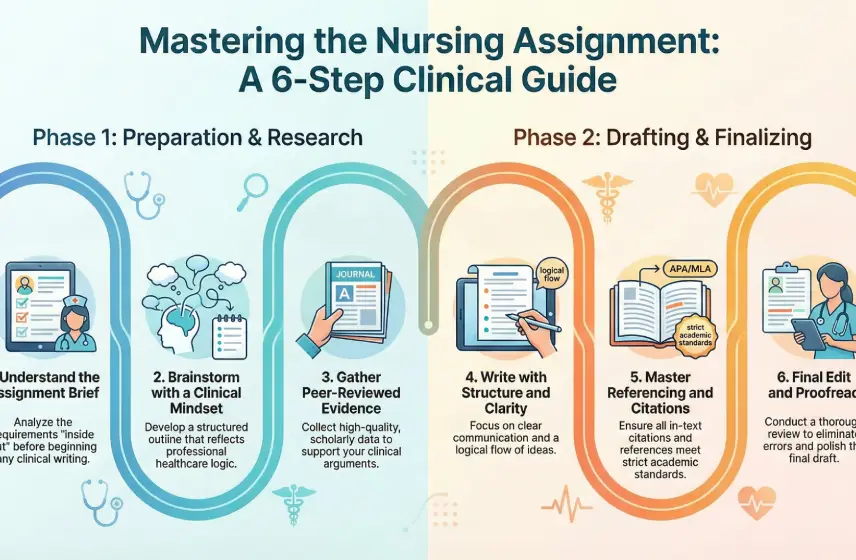
So here’s the breakdown of the steps to organise your assignment and achieve excellent grades.
Step #1: Understand the Assignment Brief Inside Out
A nursing assignment brief works as a roadmap. Read the brief multiple times and identify what’s asked of you.
These instructions include:
|
Brief Components |
What to look for |
|
Assignment details |
Unit title/code, submission date, word count, and the type of assignment (essay, care plan, case study). |
|
Learning outcomes |
The specific knowledge or skills that a student is expected to demonstrate. |
|
Task description |
A clear, detailed prompt describing what the student must do (for example, critical analysis of a situation, develop a care plan, etc). |
|
Required structure |
Specific guidelines for sections (for example, introduction, background, PICo elements, literature search strategy, conclusion, or others). |
|
Marking criteria |
The rubrics, grade descriptions, and expectations for passing. |
|
Formatting and referencing |
Requirements for font (for example, Arial 12, spacing, and citation style). |
A 2022 study in the Journal of Nursing Education showed that students who dissected the nursing assignment brief score 25% higher on average.
Step #2: Brainstorm and Outline with a Clinical Mindset
Do not dive straight into the writing process. Spend 20-30 minutes brainstorming: link your clinical rotations with the topic. For a wound care assignment, recall real cases and note evidence gaps.
Furthermore, create a simple nursing assignment outline. For example:
-
Introduction (10% of the word count): begin with a hook and include definitions of the terms. Also, discuss the objective and write a thesis statement (the main argument).
-
Main body (80% of the word count): Write a literature review to support your research, guidelines, and current statistics. Moreover, case studies (if applicable), such as patients’ medical history, assessment data, Nursing Diagnosis (NANDA), interventions, and evaluations.
-
Conclusion (10% of the word count): Restate the thesis statement (in different words) and summarise the key points discussed in the content. Make sure to add a reference list and cite all sources.
Important point:
Make sure to structure your research question using the PICO(T) framework. This helps to keep your research targeted rather than broad.
-
Population/patient: Who is the patient?
-
Intervention: What treatment or action are you considering?
-
Comparison: What is the alternative?
-
Outcome: What are you trying to measure or achieve?
-
Time: Over what time period? (optional)
Step #3: Gather Solid Evidence
Finding solid, high-quality evidence for nursing assignments requires a systematic, evidence-based practice (EBP). This approach goes beyond basic internet searches.
|
As per research, 85.4% of nursing students indicated that locating relevant articles was the most arduous task. |
Note:
When it comes to researching for nursing content, you can get help from the internet ONLY to get a basic idea of the topic.
Read: Role of Research in Nursing Assignments
The foundation of strong nursing content lies in a credible, peer-reviewed literature review and clinical guidelines. Some of the reputable resources for data collection include:
-
CINAHL: Best for nursing-specific and peer-reviewed content.
-
PubMed/MEDLINE: This is excellent for biomedical and clinical research.
-
Cochrane Library: this is the gold standard for systematic reviews and evidence-based clinical practice guidelines.
-
Google Scholar: Use this, but ensure you filter for scholarly articles and connect it to your university library.
Step #4: Write with Structure and Clarity
Now draft and use the active voice. For example, the nurse implemented the nursing care plan.
Moreover, make sure to use simple and direct language to avoid ambiguity and unnecessary jargon in the content. Also, write in the third person to maintain objectivity and avoid using ‘I’ or ‘You’ unless it's a reflective essay.
Use the SBAR (Situation, Background, Assessment, Recommendation) method to mirror clinical handoffs and impress markers.
Do not expect to get everything right on the first attempt. In the end of the day, academic writing requires practice. Therefore, if you are struggling with it, we advise getting professional nursing assignment help and making the most of it.
Step #5: Master Referencing and Citations
Nursing assignments typically require the APA 7th edition citation style. In addition, this focuses on author-date in-text citations and a corresponding reference list.
In-text Citations (APA 7th Edition)
-
Basic format: use the author’s surname and year of publication. For example, (Olivia, 2023).
-
Paraphrasing: No page number is required. However, it is encouraged to provide direct information.
-
Direct quotes: Must include the author, year, and page number (p.) or paragraph number (para.). For example, (Olivia, 2023, pt.12).
-
Multiple authors: For two authors, use both names every time. For three or more, use et al. after the first author’s name. For example, (Olivia et al., 2023).
Reference List Guidelines
-
Location by structure: The reference list comes at the end of an assignment on a new page, titled ‘References’.
-
Ordering: Alphabetical order by the first author’s surname.
-
Formatting: Double-space with a hanging indent for each entry.
-
Components: Author(s), date, title, and source. For example, DOI, URL, or publisher.
Step #6: Edit and Proofread
Editing and proofreading a nursing assignment ensures academic rigour, clarity, and adherence to clinical guidelines.
Make sure to:
-
Cross-check the structure (intro, main body, conclusion, and references) in the assignment. Each paragraph should have a clear topic sentence along with credible and relevant evidence supporting your main point.
-
Use of third-person language and avoiding colloquialisms. Ensure that nursing interventions are described using precise terminology.
-
Make sure that all in-text citations match the reference list and follow the required style.
-
Ensure a logical progression of ideas between paragraphs.
-
Read aloud your paper to identify awkward phrasing and missing words.
-
Separate passes for different issues–one pass for spelling, another for punctuation, and a final pass for formatting.
-
Check for clustered errors if one error is found.
Final Words
A clear and well-structured nursing assignment is the first thing that markers notice. By following this guide, you can transform your grade from ‘Pass’ to ‘Distinction’ and also leave a great impact on assessors.
Generally, a good way to organise your nursing assignment includes the following points:
-
Understand the assignment brief clearly
-
Brainstorm and outline with a clinical mindset
-
Gather credible and peer-reviewed evidence
-
Write with structure and clarity
-
Master references and in-text citations
-
Edit and proofread the content
FAQs
What are the 7 P’s of nursing?
The 7 P’s of nursing are Purpose, Professionalism, Personalisation, Proactivity, Partnership, Prevention, and Productivity. These strategies bring a fresh start to create a more dynamic and responsive nursing workforce.
What is the process of organising in nursing management?
Organising in nursing management is the systematic process of structuring resources, defining tasks, and establishing authority relationships to achieve patient care goals.
What is the biggest challenge for nursing students?
The biggest challenges for nursing students involve balancing rigorous academic coursework with demanding clinical rotations. Other major hurdles include navigating a high-stakes clinical environment, fear of making mistakes, and the pressure of preparing for the NCLEX exam.
Why do so many nurses quit?
Nearly 18% of registered nurses quit the profession within the first year. The common causes for leaving include stressful working conditions, lack of leadership and supervision, and understaffed facilities.